Visual Note-Taking Techniques for Better Retention
Visual Note-Taking Techniques In today’s fast-paced learning environment, students and professionals alike are constantly searching for ways to improve understanding and memory. Traditional note-taking often involves writing long paragraphs or copying information verbatim, which can make it difficult to retain key concepts. Visual note-taking techniques offer a dynamic alternative. By combining images, symbols, diagrams, and structured layouts, these methods help learners engage with material more actively and remember it longer.
Visual note-taking is more than just doodling in the margins of a notebook. It is a deliberate approach that leverages the brain’s natural ability to process visual information. Studies show that the human brain can process visuals faster than text and that images are often easier to recall than words alone. For students, teachers, and professionals in the United States, incorporating visual elements into note-taking can dramatically improve comprehension, focus, and retention.
This guide will explore the benefits of visual note-taking, key techniques to implement, and strategies to maximize retention for academic, professional, and personal learning.
What Is Visual Note-Taking?
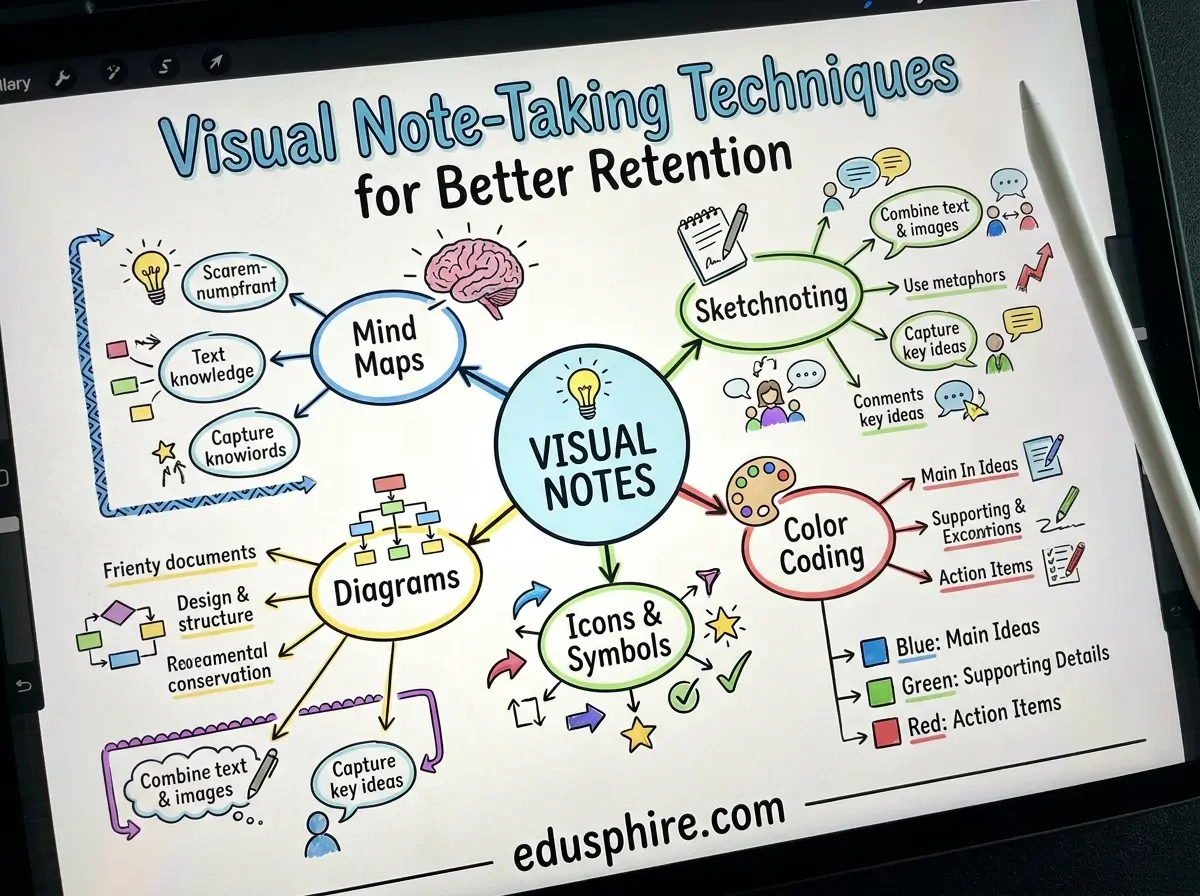
Visual note-taking, sometimes referred to as sketchnoting, combines text and visuals to capture ideas. Unlike traditional linear notes, visual notes use diagrams, icons, sketches, and spatial arrangements to represent information.
The goal is not to create artistic masterpieces but to transform information into memorable visual structures. For example, instead of writing a list of causes of the American Revolution, a student might draw a flowchart showing the chain of events. Key terms can be highlighted with symbols or color coding, while diagrams illustrate processes or relationships.
Visual note-taking encourages active engagement. When learners translate information into visuals, they process the content more deeply, which leads to better understanding and recall. It also helps with organizing ideas logically and making connections between concepts that might otherwise seem unrelated. Read The Ultimate Guide to Exam Preparation for Students.
Why Visual Notes Improve Retention
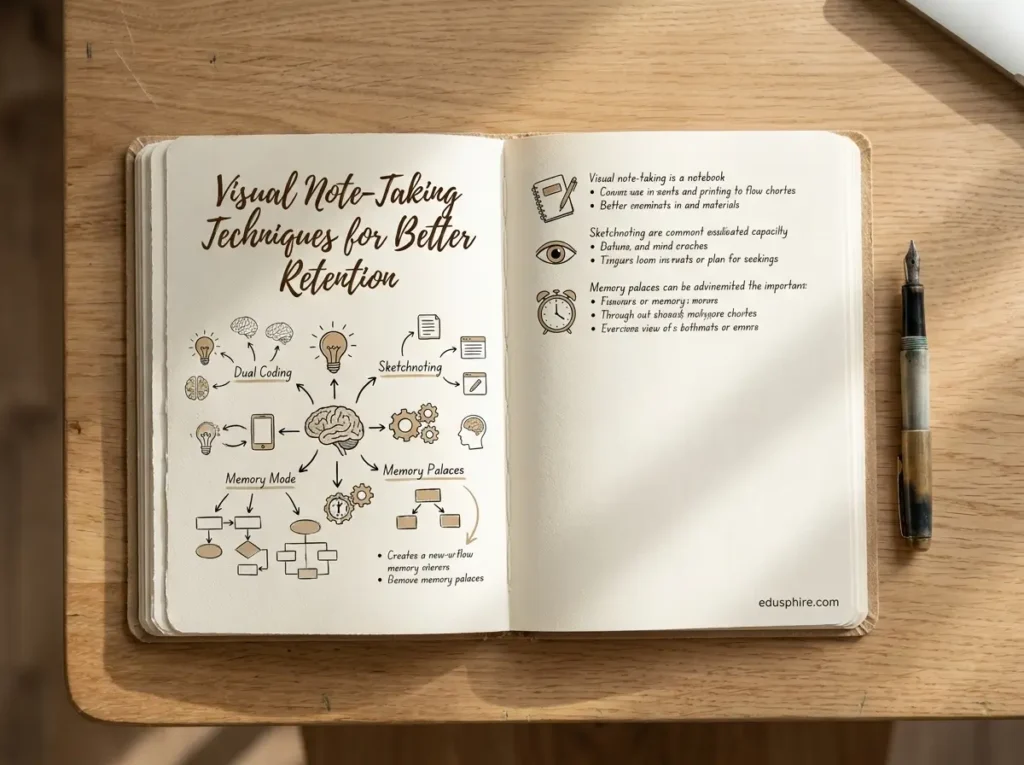
Visual note-taking improves retention because it engages multiple areas of the brain simultaneously. When you read text and create images, you use visual, spatial, and linguistic processing centers. This multisensory approach strengthens memory encoding and retrieval.
Humans naturally remember images better than words. This phenomenon, known as the picture superiority effect, explains why diagrams, charts, and sketches can make learning more effective. When information is represented visually, it is easier to recall details, identify patterns, and apply concepts in problem-solving situations.
Visual notes also reduce cognitive overload. Instead of processing dense paragraphs, learners can break information into compact, meaningful visuals. This makes complex topics easier to understand and digest, particularly in science, math, and technical subjects.
Furthermore, visual note-taking promotes active learning. Translating lectures, readings, or presentations into visual formats requires interpretation, synthesis, and summarization, all of which enhance retention and understanding.
Essential Visual Note-Taking Techniques
There are several effective visual note-taking techniques that students and professionals can use. Each technique offers unique advantages and can be adapted to various learning contexts.
Mind Mapping
Mind maps organize information hierarchically around a central topic. A main idea is placed at the center of the page, and branches radiate outward to represent subtopics and details.
This technique is ideal for brainstorming, summarizing chapters, or planning projects. It encourages creative thinking while showing connections between ideas. Mind maps can also include icons, colors, and illustrations to emphasize relationships and make the content more memorable.
For example, a student learning biology might create a mind map for the human circulatory system, with the heart at the center and branches representing arteries, veins, blood flow, and oxygen exchange.
Flowcharts
Flowcharts visualize processes and sequences of steps. They are particularly useful for procedural information, scientific experiments, algorithms, and workflows.
Each step is represented by a shape, typically a rectangle or diamond, with arrows indicating direction and decision points. This method simplifies complex processes, making it easier to understand cause-and-effect relationships.
For instance, a student studying chemistry could create a flowchart illustrating the steps of a chemical reaction, from mixing reactants to the final product. Flowcharts enhance retention by providing a clear visual pathway through information.
Concept Mapping
Concept maps show relationships between different ideas or concepts. Unlike mind maps, which often branch hierarchically, concept maps focus on linking multiple ideas in a network.
Nodes represent key concepts, and labeled lines show the relationships between them. Concept maps are especially helpful for understanding interrelated topics in subjects like history, literature, and social sciences.
For example, a history student might create a concept map connecting causes, events, and consequences of World War II. By visually displaying these connections, learners can see the bigger picture and understand how individual details fit into the overall narrative.
Sketchnoting
Sketchnoting combines handwriting, drawings, symbols, and layout to summarize information. Unlike traditional notes, which are mostly text-based, sketchnotes incorporate visuals and typography to highlight key points.
Students can use banners for headings, arrows for sequences, icons for concepts, and different fonts for emphasis. Sketchnoting encourages active engagement during lectures or readings, resulting in stronger comprehension and retention.
For instance, a student attending a psychology lecture could create sketchnotes with icons representing different cognitive processes, arrows showing cause-and-effect, and short notes summarizing key findings.
Visual Timelines
Visual timelines help learners understand events chronologically. They are ideal for history, project planning, and tracking sequential processes.
Events are placed along a horizontal or vertical line, often with brief descriptions and illustrations. Timelines make it easier to see patterns over time, identify cause-and-effect relationships, and retain chronological information.
For example, a student studying U.S. history could create a visual timeline of major presidential administrations, noting significant legislation, wars, and social movements.
Graphic Organizers
Graphic organizers are structured visual formats for organizing information. Examples include Venn diagrams, T-charts, cause-and-effect diagrams, and tables.
These tools help students categorize information, compare and contrast ideas, or analyze relationships. Graphic organizers are particularly useful for reading comprehension, critical thinking, and summarizing complex material.
For instance, a literature student could use a Venn diagram to compare two characters in a novel, visually showing their similarities and differences.
Getting Started with Visual Note-Taking
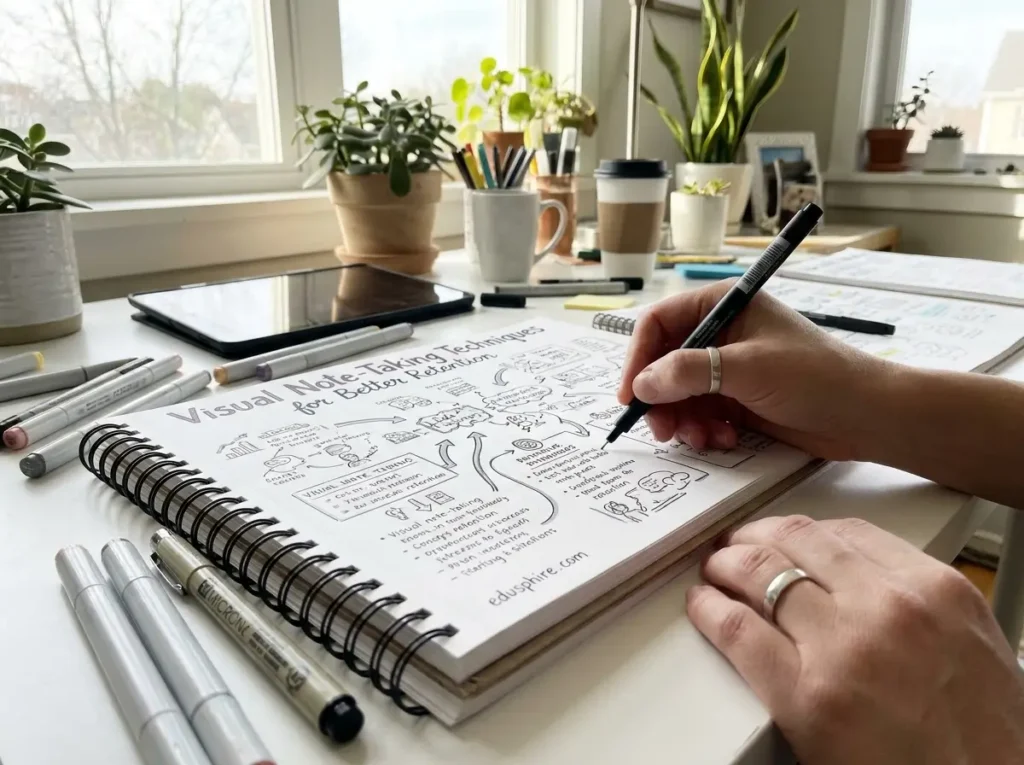
Starting with visual notes does not require artistic skill. The key is clarity and organization rather than perfection. A few simple supplies are enough: a notebook, pens of different colors, highlighters, and perhaps sticky notes for additional emphasis.
Choose a notebook that allows enough space for layouts, sketches, and diagrams. Dotted or grid notebooks are popular because they provide guidance for alignment without restricting creativity.
Begin by practicing simple techniques, like drawing icons for recurring concepts, using arrows for sequences, and highlighting keywords. Over time, you can experiment with more complex layouts like sketchnotes and concept maps.
Using Color and Symbols
Color is a powerful tool in visual note-taking. It helps differentiate topics, highlight important points, and improve memory retention. For example, you might use blue for definitions, red for critical concepts, and green for examples.
Symbols also enhance comprehension. Stars can indicate priority, checkmarks for completed tasks, and arrows for sequences or relationships. Consistent use of symbols helps your brain quickly recognize patterns, making review sessions more efficient.
The combination of color and symbols transforms notes from plain text into a visually engaging resource that is easier to understand and recall.
Integrating Visual Notes with Digital Tools
While traditional notebooks are effective, digital tools expand visual note-taking possibilities. Applications like GoodNotes, Notability, OneNote, and Miro allow students to combine sketches, typed text, images, and links in one space.
Digital platforms provide advantages such as unlimited space, easy editing, search functionality, and cloud storage. Students can insert diagrams, screenshots, or reference materials directly into their notes.
Even when using digital tools, the principles of visual note-taking remain the same: organize, highlight, and illustrate key ideas for better retention.
Techniques for Retention
To maximize retention, students should review their visual notes regularly. Covering text sections and recalling information from diagrams and sketches reinforces memory.
Active recall can be combined with visual cues. For instance, a student could cover definitions in a concept map and try to explain them using only visual symbols or connections.
Spaced repetition also enhances retention. Reviewing visual notes periodically—daily, weekly, or monthly—helps transfer information from short-term to long-term memory.
Visual Notes for Different Subjects
Visual note-taking can be adapted for almost any subject.
- Science and Math: Diagrams, flowcharts, and labeled illustrations simplify complex concepts like chemical reactions, biological processes, and geometric proofs.
- History: Timelines, concept maps, and annotated maps help students remember events, causes, and outcomes.
- Literature: Mind maps and character charts visualize relationships, themes, and plot structures.
- Business and Professional Studies: Flowcharts, tables, and sketchnotes summarize processes, frameworks, and case studies effectively.
The flexibility of visual notes ensures that they can be applied to any discipline, enhancing understanding and retention across the curriculum.
Avoiding Common Mistakes
One mistake is overcomplicating visuals. Excessive drawings, colors, or decorative elements can distract from key information. Focus on clarity, relevance, and organization.
Another common issue is inconsistency. Using different styles or layouts for each session can make notes harder to read. Establish a basic visual system and adapt it gradually.
Finally, some learners neglect review. Visual notes are most effective when used as an active learning tool. Regularly revisiting diagrams, flowcharts, and mind maps ensures lasting retention.
Tips for Effective Visual Note-Taking
Start simple and gradually incorporate more advanced techniques. Use clear headings, color coding, and simple symbols to structure information.
Combine text with visuals to reinforce understanding. Short phrases, keywords, and labels are often more effective than long sentences.
Experiment with different layouts, including mind maps, flowcharts, and sketchnotes, until you find what works best for your learning style.
Regularly review your notes, test yourself using visual cues, and update diagrams or concept maps as new information is learned. Consistency and active engagement are key to improving retention.
Benefits Beyond Retention
Visual note-taking offers benefits beyond better memory. It enhances creativity, improves focus, and promotes critical thinking. Students often find that they can identify patterns and relationships more easily when information is represented visually.
It also reduces cognitive overload. Complex topics are broken down into manageable visual components, making studying less overwhelming and more efficient.
Additionally, visual notes can serve as a motivational tool. Attractive layouts, color schemes, and creative diagrams make learning more enjoyable and engaging, encouraging consistent study habits.

Conclusion
Visual note-taking techniques are a powerful tool for students, professionals, and lifelong learners in the United States who want to improve retention, comprehension, and organization. By incorporating diagrams, mind maps, flowcharts, sketch notes, and other visual strategies, learners engage actively with information, making it easier to recall and apply.
From science to literature, history to business, visual notes provide flexible, creative ways to capture ideas and make sense of complex material. Regular review, active recall, and thoughtful use of color and symbols enhance the benefits of visual note-taking, transforming notes into an effective learning resource.
Whether using paper notebooks or digital platforms, students can start small, experiment with layouts, and gradually adopt a visual note-taking system that improves understanding, retention, and overall academic performance.
By embracing visual note-taking techniques, learners can turn their study sessions into productive, engaging, and memorable experiences.