
Creative Visual Memory Tools for Students
Studying in college or high school is not just about reading textbooks and memorizing facts. Tools for Students In the modern student’s world, information comes fast and often feels overwhelming. From lectures and textbooks to online videos, slides, and group projects, students need ways to retain knowledge efficiently. One of the most effective methods is using creative visual memory tools. These tools harness the power of images, colors, spatial arrangements, and visualization to make learning more engaging, effective, and long-lasting.
Visual memory is a natural way the brain processes and recalls information. Studies show that humans remember images far more easily than plain text. By transforming abstract ideas into visual cues, students can retain more information with less effort. Whether preparing for exams, working on complex projects, or learning new languages, creative visual memory tools offer an innovative approach to studying that aligns with the way the brain naturally works.
In this guide, we will explore a variety of visual memory tools that every student can incorporate into their study routine. These methods are practical, easy to implement, and adaptable to any subject or academic level. Whether you are a high school student tackling chemistry formulas, a college student memorizing legal terms, or a graduate student organizing research, these techniques can help transform the way you study.
Why Visual Memory Tools Matter
Students often rely heavily on rote memorization: reading, highlighting, and repetition. While this approach can work, it is limited because it engages only one form of learning—textual or verbal memory. Visual memory tools engage multiple cognitive pathways: images, spatial memory, color recognition, and association. This multi-sensory approach improves recall, comprehension, and understanding.
For students in the United States, with their rigorous schedules and diverse curricula, visual memory tools offer a practical advantage. They reduce the time spent re-reading materials and make review sessions more engaging. Visual methods also help students see patterns, relationships, and hierarchies in information that might otherwise remain abstract or confusing.
Moreover, these tools encourage active learning. Instead of passively reading or listening, students create, interact with, and manipulate information visually. This not only strengthens memory but also makes the study process more enjoyable. Read The Ultimate Guide to Effective Student Notes.

1. Mind Mapping
One of the most popular visual memory tools is the mind map. Mind maps use branches, colors, and images to represent ideas and their relationships. A central concept is placed at the center of a page, with subtopics branching out like tree limbs. Further details are added as smaller branches.
Tools for Students Mind maps are particularly effective for organizing complex information. For example, when studying history, a student could place “World War II” in the center and branch out to causes, major battles, key leaders, and consequences. Each subtopic can include short notes, dates, or symbols.
The visual structure helps the brain see connections between ideas, making recall easier. Mind maps are also flexible. Students can create them by hand using colored pens and paper, or digitally with apps that allow drag-and-drop organization. Adding images or icons to each branch can further enhance memory by creating visual associations.
Mind mapping works for any subject, from biology and literature to languages and business studies. It is especially helpful for essay planning and exam review because students can see the entire topic at a glance.
2. Infographics for Study Summaries
Infographics condense information into visually appealing charts, diagrams, and images. They allow students to transform dense text into digestible visual formats. By summarizing key points into graphics, students engage visual memory and improve comprehension.
For example, a student studying the water cycle could create an infographic showing evaporation, condensation, precipitation, and collection with arrows, colors, and labels. Biology students can depict processes like cellular respiration or photosynthesis. History students can illustrate timelines, cause-and-effect relationships, or battles.
Tools for Students Creating infographics is itself a memory exercise. Designing symbols, choosing colors, and arranging elements spatially forces students to process information actively. Once created, infographics serve as highly effective review tools that are easy to recall during exams.
Digital tools like Canva, Piktochart, or simple drawing software can make infographics accessible. For tactile learners, hand-drawn infographics on large sheets of paper or notebooks work just as well.
3. Flashcards with Visual Cues
Flashcards are a classic memory tool, but adding visuals enhances their effectiveness. Instead of only writing a term and definition, students can include small images, diagrams, or symbols that represent the concept. For example, a biology flashcard for “mitosis” could feature a small sketch of chromosomes dividing.
Color coding flashcards is another useful strategy. Different colors can represent categories, difficulty levels, or related topics. For foreign language students, pairing words with pictures strengthens vocabulary recall. A visual cue often triggers memory faster than text alone.
Flashcards are also portable. Students can review them between classes, on the bus, or during study breaks. Digital flashcards on apps like Quizlet allow image integration, gamification, and spaced repetition, making review sessions more interactive and efficient.
4. Timelines and Sequential Charts
Many subjects involve sequences, dates, or chronological events. Timelines are visual memory tools that transform lists of dates and events into horizontal or vertical diagrams. Students can see the flow of history, development stages, or procedural steps at a glance.
For instance, a U.S. history student studying the civil rights movement can create a timeline marking landmark events, laws, and leaders. Science students can chart stages of mitosis, chemical reactions, or geological processes. A visual sequence helps the brain remember order and causality, making recall during exams more natural.
Timelines can be simple with hand-drawn lines and notes, or digitally enhanced with icons, color-coded sections, and visual separators. Interactive timelines in study apps also allow students to zoom in on specific events for detailed review.
5. Diagrams and Flowcharts
Diagrams and flowcharts are excellent for representing processes, hierarchies, or relationships. They simplify complicated information into visual logic. For example, students can use a flowchart to map decision-making in business case studies, steps in a chemical reaction, or grammar rules in language learning.
Hierarchical diagrams can help visualize concepts with multiple levels, such as biological classification, legal structures, or organizational charts. Flowcharts with arrows, colors, and boxes allow the brain to follow processes step by step. This method is particularly effective for students who struggle with memorizing linear text.
Creating diagrams actively engages students in the material. Rather than simply reading, they must interpret, categorize, and organize information in a visual format. This active involvement strengthens memory and understanding.
6. Color Coding and Highlighting Strategically
Color coding is more than aesthetic—it is a powerful visual memory tool. Students can assign specific colors to subjects, topics, or types of information. For example, red can indicate important dates, blue for definitions, and green for examples or formulas.
Highlighting with purpose, rather than randomly marking text, reinforces memory. Students are encouraged to actively process the information while choosing which parts to emphasize. Over time, the brain associates colors with content, making recall faster.
Combined with notes, diagrams, or flashcards, color coding creates a multi-layered visual memory system. The brain remembers patterns and visual cues as much as words.
7. Mnemonic Imagery
Mnemonic imagery combines visual and verbal memory. Instead of using abstract mnemonics alone, students create mental images to associate with the information. For example, to remember the Great Lakes (Huron, Ontario, Michigan, Erie, Superior), a student can visualize a house with windows labeled H, O, M, E, S. The quirky mental image creates a strong memory trigger.
Mnemonic imagery works for vocabulary, formulas, historical events, scientific processes, and lists. The more unusual or vivid the image, the more likely it is to stick. Students can make the image absurd, funny, or dramatic—anything that grabs attention.
The technique is especially effective for visual learners because it turns abstract information into memorable mental pictures.
8. Sketch Notes
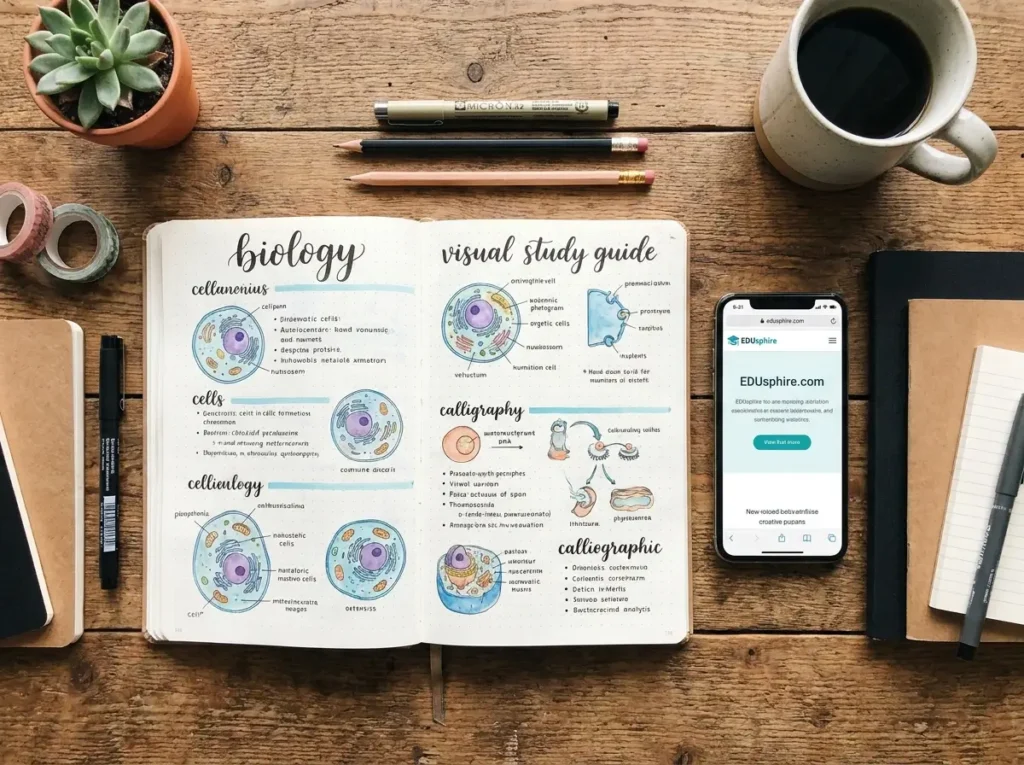
Sketch notes are a hybrid between traditional note-taking and visual diagrams. Students combine words, sketches, arrows, icons, and layouts in a notebook to represent lectures or readings. Sketch notes emphasize relationships, key ideas, and memory hooks instead of full sentences.
For example, a psychology student learning about the nervous system could draw simplified neurons, label them, and add brief notes on function. A history student could illustrate a timeline with mini-sketches representing major events. Adding arrows, boxes, and colors creates an integrated visual memory map.
Sketch notes promote active listening, engagement, and creativity. The act of drawing while summarizing reinforces comprehension and long-term memory.
9. Mind Palace Visualization
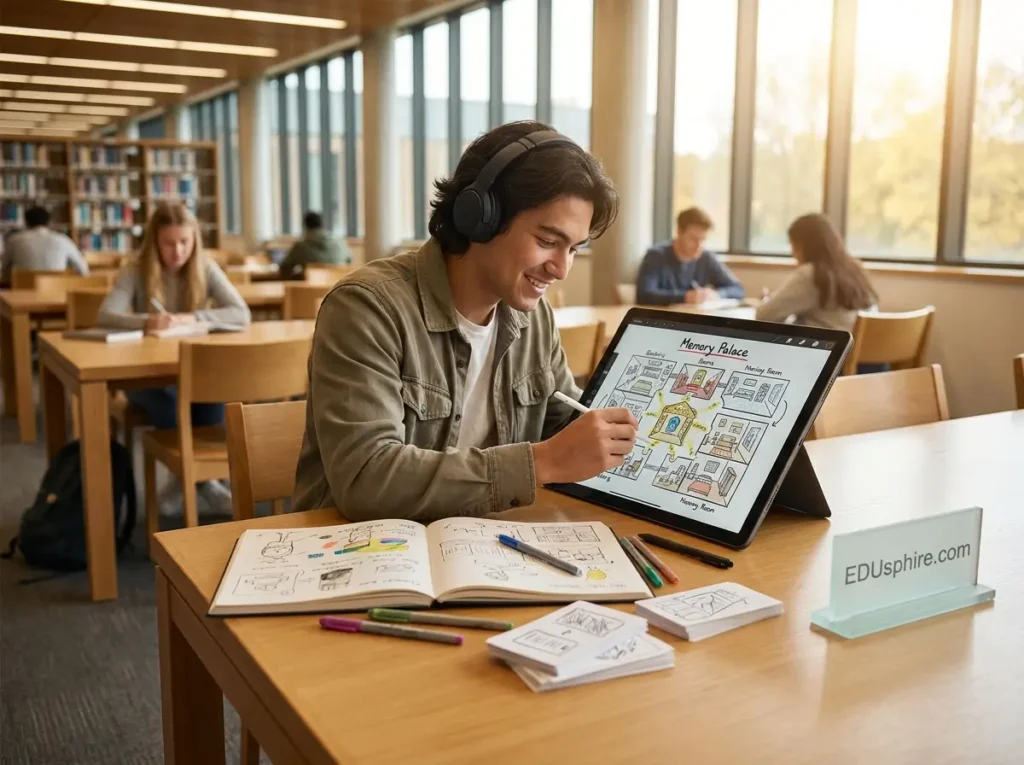
The mind palace technique is a classic memory tool that leverages spatial memory. Students imagine a familiar place, like their home, and place pieces of information in specific locations. Later, recalling the information involves mentally “walking” through the space.
For example, a student memorizing anatomy could place organs in different rooms of their imaginary house. When recalling, they imagine walking through the rooms and visualizing each organ in its spot. The brain remembers spatial arrangements effectively, making recall faster and more reliable.
This technique is highly flexible. Students can use it for historical dates, language vocabulary, chemical elements, formulas, or lecture points. The more vivid the imagined space, the stronger the memory.
10. Infused Visual Mnemonics
Combining mnemonics, colors, and images enhances memory further. For example, when learning the periodic table, a student can associate each element symbol with a colorful mental image, link it with a memorable story, and even draw it in notes.
These infused visual mnemonics work across disciplines: math formulas, grammar rules, biology cycles, or programming concepts. By layering visual and cognitive cues, students create robust memory networks that are easier to recall under pressure.
11. Interactive Digital Tools
Many students prefer digital tools to complement traditional methods. Mind-mapping apps, diagram creators, flashcard software, timeline builders, and drawing apps allow students to combine visuals, text, color, and interactivity. They also make sharing and collaboration easier.
Students can create digital mind maps, attach images, link resources, or integrate with study schedules. For example, a student learning world geography could create an interactive map highlighting countries, capitals, landmarks, and dates of independence. Interactive elements make the information more engaging and easier to remember.
Digital tools also allow quick adjustments. Unlike physical diagrams or notes, apps let students rearrange concepts, add new material, and visually organize ideas without erasing or rewriting.
12. Using Whiteboards or Large Posters
A whiteboard or large poster can transform a dorm room, bedroom, or study corner into a visual memory hub. Students can write formulas, draw diagrams, list timelines, or map out essay structures. Large formats allow students to see the entire concept at once, improving spatial memory.
Colorful markers, sticky notes, and icons make the information more engaging. The act of writing and visualizing simultaneously strengthens retention. Whiteboards are also reusable, so students can refresh information frequently as they review and revise.
13. Combining Audio and Visual Cues
Some students remember information best when multiple senses are involved. Pairing visual memory tools with audio cues—like recording lectures, using mnemonic songs, or narrating diagrams—creates stronger memory links.
For instance, a student could draw a flowchart of a biological process while recording themselves explaining each step. Later, listening while reviewing the chart reinforces recall through dual sensory pathways.
Combining audio with visuals also suits students who struggle with written memorization alone. It engages more areas of the brain, making study sessions more efficient and effective.
14. Gamifying Visual Memory
Turning study into a game is a creative approach to visual memory. Students can create quiz cards with images, match diagrams to labels, or design puzzles based on lecture material. Group study sessions can involve competitive memory games where visuals play a central role.
Gamification increases engagement and motivation. The interactive aspect encourages repeated review, which strengthens memory. By turning learning into a playful challenge, students retain information more naturally without feeling stressed.
15. Layering Information Visually
Layering information involves building visual complexity gradually. For example, a student might start with a basic diagram of the human heart. Later, they add color-coded blood flow, labels for chambers, and arrows for oxygen-rich vs. oxygen-poor blood. Each layer adds depth, reinforcing memory incrementally.
This method works well for subjects with multiple levels of detail, like anatomy, chemistry reactions, grammar structures, or historical timelines. Layering encourages active review because the student revisits the material multiple times while creating new associations.
16. Visualization Before Sleep
Visualization is a subtle but effective visual memory tool. Before sleeping, students can mentally rehearse diagrams, timelines, vocabulary, or processes. This practice helps consolidate memory during rest.
For example, a student studying the water cycle could imagine rain falling, water collecting in rivers, evaporating into clouds, and condensing again. By visualizing the sequence in detail, the brain strengthens neural connections related to the material.
This technique is particularly helpful for high-pressure exam periods. Visualization before sleep supplements other study methods without requiring additional physical time.
17. Using Colorful Stationery for Memory Anchors
Colorful stationery—pens, highlighters, sticky notes—serves as more than decoration. It creates memory anchors. Students often remember concepts based on their color association. Red might mark critical formulas, yellow for definitions, green for examples, and blue for historical dates.
Stationery with bright, contrasting colors also makes notes visually appealing. Students are more likely to engage with notes they enjoy looking at, increasing the probability of recall. Color becomes both a memory aid and a motivational tool.
18. Spatial Arrangement of Notes
The way notes are arranged on a page influences recall. Students can place related concepts together, use diagrams to connect ideas, or create clusters of keywords and images. Spatial memory is powerful: the brain remembers patterns, positions, and visual relationships.
For example, in chemistry, placing reactants on the left, products on the right, and arrows in between helps students visualize reactions. In literature, placing themes, characters, and quotes in a cluster aids essay writing. Spatial arrangement makes studying more intuitive.
19. White Space and Minimalism in Visual Notes
While visuals are helpful, overcrowding can backfire. Students should use white space strategically to avoid overwhelming the brain. Minimalist visual notes highlight key concepts, relationships, and memory cues.
Clear diagrams, concise labels, and selective highlighting create visual breathing room. This allows students to focus on what is important, improving both comprehension and retention.
20. Combining Multiple Visual Tools
The most creative visual memory setups combine several methods. For example, a student might create a mind map, use color coding, draw diagrams, make flashcards, and layer information over time. By integrating tools, students engage multiple cognitive pathways and create redundancy in memory, which improves recall.
Different tools suit different subjects. History might benefit from timelines and mind maps. Biology from diagrams, flowcharts, and layer visualization. Language learning from flashcards, imagery, and mnemonic symbols. Math from visual patterns, diagrams, and color-coded formulas.
The key is experimentation. Students can try different combinations to find what enhances their memory most effectively.
21. Review and Update Visual Tools Regularly
Visual memory tools are most effective when reviewed consistently. Students should revisit diagrams, flashcards, mind maps, and infographics frequently. Updating visuals with additional details or corrections reinforces memory and ensures accuracy.
Active engagement during review strengthens long-term retention. Students who simply glance at a static diagram are less likely to remember it than those who redraw, annotate, or explain it to themselves.
22. Encouraging Creativity to Boost Memory
Creativity is central to effective visual memory. The more imaginative and personal a visual cue is, the easier it is to remember. Students should feel free to add colors, doodles, humor, or personalized symbols. A quirky drawing or mnemonic often creates a stronger memory than a simple textbook diagram.
Creative involvement also increases motivation. Students enjoy the process and are more likely to study consistently. Engagement and memory are tightly linked, making creativity a powerful ally in learning.
23. Visual Summaries for Exam Prep
At exam time, students can create condensed visual summaries. A single page may include mind maps, diagrams, timelines, key definitions, and color-coded notes. The goal is to have a quick reference that captures essential content at a glance.
Visual summaries are particularly helpful in last-minute review because they reduce overwhelm. Students can see patterns and connections quickly, recall information faster, and feel more confident.
24. Visual Collaboration
Working with peers enhances visual memory. Students can create collaborative diagrams, share infographics, or collectively draw mind maps. Discussing visuals helps verbalize concepts, clarify misunderstandings, and reinforce learning.
Group study sessions can involve drawing, explaining, and iterating on visual tools. Collaboration turns passive memorization into active, engaging learning.
25. Personalizing Visual Memory Techniques
Ultimately, the most effective visual memory tools are personalized. What works for one student may not work for another. Some prefer sketches; others prefer colors. Some thrive on digital tools, others on hand-drawn notes. Some benefit from layering, some from minimalism.
Students should experiment, refine, and adapt techniques to fit their learning style, subjects, and schedule. The combination of creativity, active engagement, and consistency is what makes visual memory truly powerful.
Conclusion: Visual Tools Transform Study Into Active Learning
Creative visual memory tools are game-changers for students. They make studying engaging, efficient, and aligned with how the brain naturally retains information. From mind maps and infographics to flashcards, diagrams, color coding, and mnemonic imagery, these methods turn abstract information into memorable, tangible, and retrievable knowledge.
Students in the United States face demanding academic workloads. Incorporating visual tools allows them to study smarter, recall faster, and reduce stress. Whether preparing for exams, writing papers, learning languages, or mastering complex concepts, visual memory tools give students a competitive edge.
The key is practice. Students should explore different tools, integrate multiple methods, personalize them, and review consistently. Creativity, color, spatial awareness, and engagement all strengthen memory. With the right visual strategies, students can transform learning from a passive task into an active, enjoyable, and highly effective experience.
Incorporating these techniques into daily study routines helps students retain more information, boost confidence, and ultimately achieve academic success. Visual memory is not just a study aid—it is a pathway to smarter, more effective, and more enjoyable learning.